
How to Create an Effective Assessment Plan for Vocational Courses in the UK
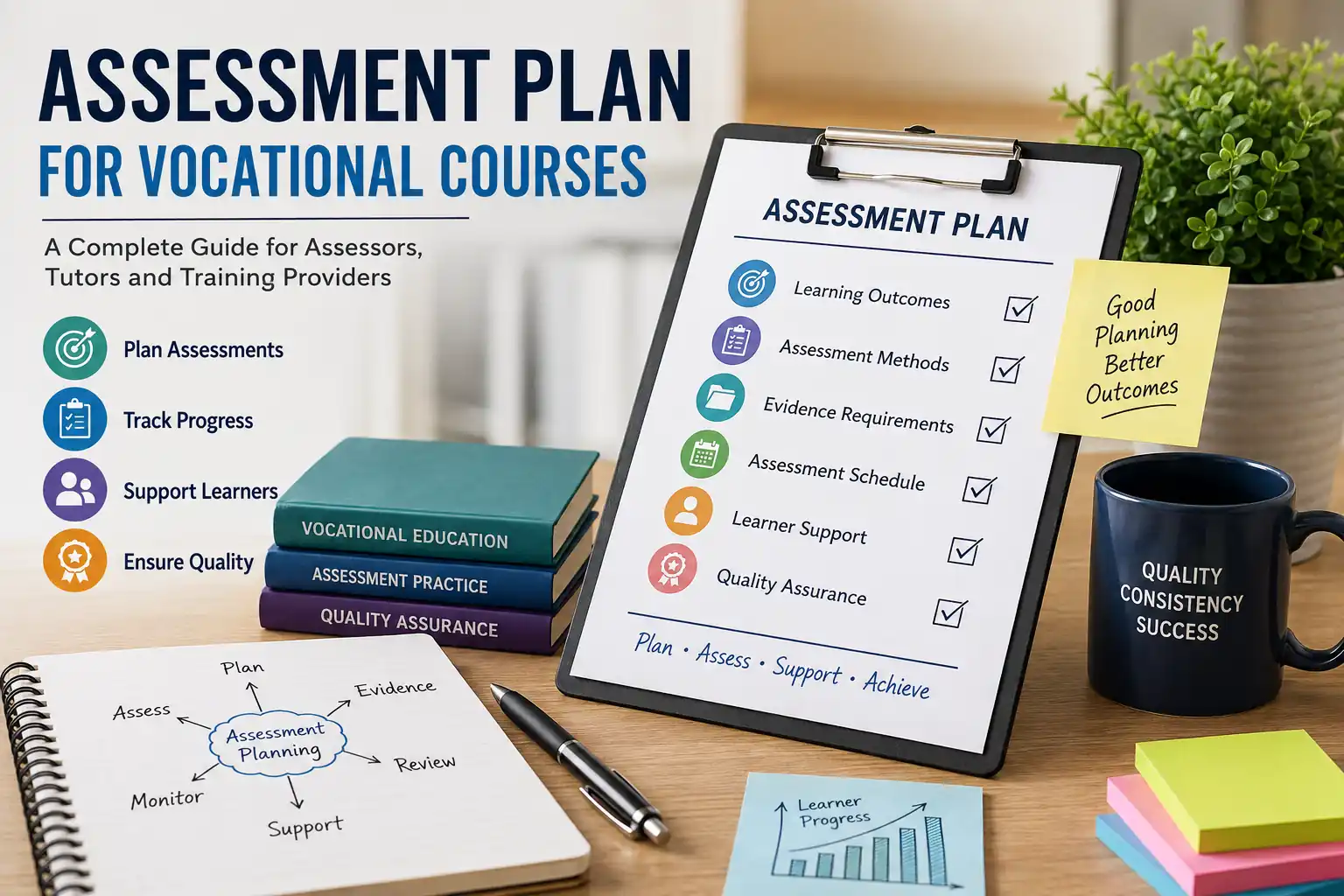
A clear assessment plan for vocational courses helps learners know what to do and when to do it. It also helps assessors track evidence and give timely feedback.
The plan links each learning outcome to suitable assessment methods. It sets out the evidence needed, deadlines, support and review points.
This applies across care, teaching, business and other vocational subjects.
Without a plan, learners may miss deadlines or submit incomplete work. Assessors then need to chase evidence.
Internal Quality Assurers (IQAs) may also find gaps when they sample portfolios.
This guide covers a ten-step planning process. It explains how to choose methods, organise learner evidence and plan quality checks.
What Is an Assessment Plan for a Vocational Course?
An assessment plan sets out what a learner must do, how their work will be assessed and when assessment will take place. It also names the people responsible.
The plan links each task to the learning outcomes and assessment criteria. Include:
- The units and criteria to be assessed.
- The tasks, methods and evidence needed.
- Target dates and progress reviews.
- Feedback and support arrangements.
- Internal quality assurance (IQA) checks where needed.
Learners can use the plan to organise their work. Assessors can use it to check progress and spot gaps.
Why Assessment Planning Matters in Vocational Education
Vocational courses prepare learners for real work. Assessment often covers both knowledge and practical skills. Evidence may be gathered over several weeks in a workplace.
A clear plan helps prevent:
- Missed deadlines.
- Gaps or repeated work in a portfolio.
- Last-minute requests for evidence.
- Rushed quality checks.
- Avoidable delays in certification.
Choose evidence methods that the qualification allows. These may include observations, discussions, assignments, witness reports and work products. Tell the learner what is needed before they start.
Benefits of a Well-Planned Assessment Strategy
An effective assessment plan benefits learners, assessors and training providers.
Benefits for learners
- clear expectations from the start;
- better organisation of workload;
- reduced stress before deadlines;
- regular feedback opportunities;
- greater confidence in progress; and
- improved chances of timely achievement.
Benefits for assessors
- more organised learner management;
- more consistent assessment decisions;
- easier evidence tracking;
- less time spent chasing overdue work; and
- better preparation for quality assurance activities.
Benefits for training providers
- stronger learner completion and satisfaction;
- more consistent assessment practice;
- better alignment with awarding-organisation requirements;
- clearer evidence for IQA and EQA activity; and
- fewer avoidable delays at certification stage.
Assessment Plan vs Assessment Strategy
The two terms describe different things.
Assessment strategy
This is the overall approach set by the provider or awarding organisation. It covers approved methods, evidence rules, assessor requirements and quality checks.
Assessment plan
This applies those rules to a learner or group. It gives the tasks, dates, methods and people involved.
The strategy sets the rules. The plan shows how you will use them during the course.
Make clear when each activity supports learning and when it contributes to a final decision. The formative vs summative assessment guide gives examples of these different purposes. If you are preparing for an IQA qualification, the assessor to IQA progression guide explains how responsibility expands from individual assessment plans to reviewing assessment quality.
Understand Learning Outcomes Before Planning Assessments
Start with the current qualification specification. Check the learning outcomes, assessment criteria and required units before planning tasks.
Also check the rules for unit choices, workplace evidence and observations. Ask:
- What must the learner know?
- What must they be able to do?
- What evidence will show this?
- Which methods does the qualification allow?
Then set tasks and dates. Planning in this order helps you avoid gaps and unnecessary work.
SJA Professional Insight
At SJA Global Academia, we encourage assessors to plan around the learner's work and progress.
Set realistic tasks and review dates. Give feedback while the learner still has time to act on it. Use evidence from real practice where the course requires it.
The same approach helps in care, teaching, business and assessment courses. Clear planning supports learners while keeping the qualification standard.
How to Create an Effective Assessment Plan Step by Step
An assessment plan for vocational courses turns the course requirements into tasks the learner can follow.
Use these ten steps to decide what will be assessed, how to gather evidence and when to review progress. Adapt the dates to the learner and the setting.
1. Review the Qualification Specification and Assessment Guidance
Read the current specification and assessment guidance from the awarding organisation. Check the required units, learning outcomes and assessment criteria. Note any rules for workplace practice, observations or specialist evidence.
Look at the action verbs. Describe, explain and evaluate may be assessed through written work or discussion. Demonstrate, carry out, apply, use and perform usually call for evidence of practice.
Follow the qualification's evidence rules. A written task cannot replace required practical evidence.
2. Break Down the Learning Outcomes and Assessment Criteria
Create a map that links each task to its criteria. Check that every criterion is covered and that tasks do not repeat the same work without a reason.
Separate the evidence types:
- Knowledge: answers, explanations and analysis.
- Skills: an assessor watching a task.
- Products: plans or documents made at work.
- Supporting evidence: witness reports, discussion or reflection.
Where the rules allow it, one real activity may cover several related criteria. Map the evidence carefully.
3. Understand the Learner and Their Starting Point
Use induction and initial assessment to find out what the learner already knows. Discuss their experience, English skills, digital skills and workplace access.
Ask about shift patterns, caring duties and support needs. Check whether suitable tasks and witnesses will be available at work.
Reasonable adjustments can help a learner access an assessment. They must keep the skills and standard being assessed.
4. Select Assessment Methods That Match the Criteria
Choose a method that can show the required knowledge or skill. Check that the awarding organisation allows it.
Options may include:
- Direct observation.
- Professional discussion.
- Assignments and questions.
- Portfolios and work products.
- Witness reports and reflective accounts.
- Projects or case studies where allowed.
- Recognition of prior learning where approved.
You may need more than one method. For example, watch a learner carry out a task, then ask why they chose that approach.
5. Decide What Evidence Will Be Collected
Tell the learner exactly what to submit for each task. State the format, criteria and how the evidence will be judged.
Evidence must be:
- Valid: it meets the relevant criteria.
- Authentic: it is the learner's own work.
- Current: it shows present skills where this matters.
- Sufficient: there is enough to make a decision.
- Reliable: another competent assessor could reach a similar decision.
“Upload evidence” is too vague. Name the task and documents needed so the learner can prepare.
6. Build a Realistic Assessment Schedule
Spread tasks across the course. Allow time to learn, practise, gather evidence, receive feedback and resubmit work.
Include dates or windows for:
- Induction and initial assessment.
- Assignments and observations.
- Portfolio checks and progress reviews.
- Feedback and resubmission.
- IQA sampling and final completion.
Workplace tasks may not happen on a fixed date. Agree an observation window when this makes the plan more realistic.
7. Agree the Plan With the Learner
Talk through the tasks, evidence, dates and support with the learner. Check that they understand what to do and how to contact the assessor.
Ask about barriers such as workplace access, digital uploads or competing duties. Record the actions you agree.
Review the plan when circumstances change. Learners should know why a task is required and how it helps them complete the course.
8. Include Support, Feedback and Review Points
Build support into the plan. Use tutorials, evidence checks and progress reviews to help the learner stay on track.
Feedback should state what they achieved, what is missing and what to do next.
A missed deadline may signal unclear instructions, low confidence or limited workplace access. Discuss the cause early and agree a practical next step.
9. Integrate Internal Quality Assurance From the Start
Plan IQA checks from the start. These may include sampling evidence, observing assessors, checking feedback and meeting learners.
Include standardisation meetings so assessors can compare decisions. Give extra attention to higher-risk units, learners or assessors.
Early checks leave time to correct problems. Assessors should know what may be sampled and which records to keep.
10. Monitor, Update and Record Changes
Review the plan as the learner progresses. Update it when work opportunities, support needs or dates change.
Record:
- Completed tasks, decisions and feedback.
- Missed or rearranged assessments.
- New deadlines and support actions.
- Any further evidence needed.
- The learner's agreement to major changes.
Keep changes fair and clear. A revised schedule must still meet the qualification requirements.
What Should an Assessment Plan Include?
Although formats vary between centres, a practical vocational assessment plan should normally include:
- learner and assessor details;
- qualification, unit and assessment-criteria references;
- planned assessment activities and methods;
- evidence to be produced;
- target dates or assessment windows;
- location or platform for assessment;
- people involved, including witnesses where relevant;
- support and reasonable-adjustment arrangements;
- feedback and review dates;
- IQA or sampling information where appropriate;
- actual completion dates; and
- learner and assessor agreement.
The plan should be detailed enough to guide delivery but simple enough for learners and staff to use consistently.
A Practical Assessment Plan Example
Imagine a Level 3 learner studying while working full-time. A simple 18-week outline could include:
| Week | Assessment activity | Purpose |
|---|---|---|
| 1 | Induction and evidence briefing | Explain course requirements, deadlines and evidence expectations. |
| 3 | First knowledge task | Build confidence and assess initial understanding. |
| 5 | Observation planning | Prepare for practical assessment in a real or approved setting. |
| 8 | Progress review | Check progress, barriers and the learner action plan. |
| 10 | Portfolio checkpoint | Review submitted evidence and identify gaps. |
| 14 | Professional discussion | Confirm knowledge, judgement and practical understanding. |
| 18 | Final evidence review | Complete outstanding work and prepare for quality checks. |
The exact schedule will vary by qualification. The value of the example is its balance: learners receive clear milestones, while assessors have planned opportunities to review progress and resolve gaps before completion.
Planning for Online and Blended Vocational Courses
Online learners need clear instructions and regular contact. Explain where to upload work, which file types to use and how to name files.
Agree short milestones, online reviews and feedback dates. Make a backup plan for technical problems or delayed workplace tasks.
Online study still needs practical evidence where the qualification requires it. Explain how observations will be arranged and how evidence will be checked.
Common Problems Caused by Weak Assessment Planning
Many apparent learner problems are actually symptoms of weak systems. Poor planning can lead to:
- missed or conflicting deadlines;
- incomplete evidence portfolios;
- assessors working reactively;
- inconsistent assessment decisions;
- learners becoming disengaged or withdrawing;
- delayed internal verification and certification;
- rushed IQA sampling;
- stress before external quality assurance activity; and
- complaints and reputational damage.
A strong plan does not eliminate every challenge, but it makes problems visible earlier and provides a shared framework for responding to them.
Choosing the Right Assessment Methods
Choose methods after reading the criteria and evidence rules. Decide whether the learner needs to explain something, show a skill or do both.
A poor choice can leave gaps and create more work. Most vocational courses use several methods to build a clear picture of the learner's knowledge and practice.
Match the Method to the Assessment Criteria
Review each learning outcome and assessment criterion before choosing the method. Consider what the learner must know, what they must demonstrate, whether the criterion requires knowledge, competence or both, and whether authentic evidence can be collected naturally in the workplace.
| Action verb | Possible assessment method |
|---|---|
| Explain | Written assignment or professional discussion |
| Describe | Assignment or structured questioning |
| Identify | Oral questioning or assignment |
| Demonstrate | Direct observation |
| Carry out | Workplace observation |
| Implement | Observation supported by product evidence |
| Evaluate | Assignment or professional discussion |
| Analyse | Written assignment |
| Plan | Planning document with supporting evidence |
| Produce | Product evidence, often supported by observation |
The selected method must remain valid, authentic, sufficient and reliable. Practical competence should not be assessed through written work alone where direct performance evidence is required.
Observation
Observation lets an assessor watch the learner work. It can show whether they carry out a task safely and consistently.
Examples include teaching a session, providing care, assessing a learner or serving a customer. The assessor records what they saw and links it to the criteria.
Follow the course rules for the setting and number of observations.
Professional Discussion
A professional discussion is a planned conversation about the learner's work. It lets them explain decisions and show knowledge that an observation may not reveal.
You might discuss a safeguarding decision, a legal duty or a difficult workplace event. Record the discussion and link the answers to the relevant criteria.
Written Assignments
Written tasks can assess knowledge. Learners may explain ideas, compare approaches, analyse rules or justify decisions.
Use a clear brief that matches the action verb and level. Written answers cannot replace required evidence of practical skills.
Portfolio, Witness and Product Evidence
A portfolio brings evidence together. It may hold assignments, observation reports, discussions, reflection and workplace documents.
A witness report can confirm what a supervisor, manager or colleague saw. Check that the witness understands the task. Such reports usually support direct assessment rather than replace it.
Work products may include lesson plans, risk assessments, care plans or meeting records. Check that each item is the learner's own work and meets the relevant criteria.
Avoid Over-Assessing Learners
Ask for enough evidence to make a sound decision. A large portfolio is not always a strong one.
Where the course rules allow it, use one real activity for several related criteria. This avoids repeated tasks and gives a clearer picture of normal work.
Planning Around Naturally Occurring Evidence
Look for evidence in the learner's normal work. One event may produce an observation, a discussion and useful documents.
Map each item to the criteria it actually meets. Do not force one item to cover everything. Check for gaps and plan further evidence where needed.
Supporting Different Types of Learners
Discuss each learner's experience, confidence and support needs. Consider their English, digital skills, working hours and access to suitable tasks.
Adjust the plan so they have a fair chance to show what they can do. Everyone must still meet the same qualification standard.
Practical Example: Two Learners, One Qualification
Imagine two learners completing the same qualification. Learner A works full-time in the sector, while Learner B attends a placement only two days each week.
Both learners must meet the same assessment criteria, but their schedules may differ. Learner A may generate observation opportunities through everyday duties.
Learner B may need more deliberate coordination with the placement supervisor to ensure suitable activities occur. A flexible plan supports both learners without changing the required standard.
Integrating Internal Quality Assurance into the Plan
IQA helps the centre check that assessment decisions are sound and consistent. Plan checks before problems affect the learner's progress.
Link the plan to sampling dates, assessor meetings, portfolio reviews and actions from IQA feedback. This also helps the centre prepare for external quality checks.
Common Assessment-Planning Mistakes
- Planning before reviewing the qualification: activities are created without checking learning outcomes, criteria and evidence requirements.
- Using one method for everything: written assignments are used even where observation or workplace evidence is required.
- Over-assessing: learners are asked to produce unnecessary or repetitive evidence.
- Ignoring naturally occurring evidence: genuine workplace opportunities are missed.
- Leaving IQA until the end: quality risks are discovered too late.
- Failing to review the plan: changes in employment, placement or learner circumstances are not reflected.
Assessment Planning for Online and Blended Learning
Keep the same evidence standard in online, blended and classroom courses.
Plan an online induction, tutorials and clear upload instructions. Set realistic dates and keep evidence secure. Agree what to do if a workplace observation is delayed.
Technology can help with reminders and feedback. The assessor must still judge whether the evidence meets the criteria.
Assessment Planning Checklist
Before agreeing an assessment plan, check the following:
Qualification requirements
- All learning outcomes and assessment criteria have been reviewed.
- Mandatory practical, workplace and observation requirements are identified.
- The current qualification specification and rules of combination have been checked.
Assessment methods
- Each method matches the relevant action verb and evidence requirement.
- Naturally occurring evidence is used where appropriate.
- Knowledge evidence and competence evidence are clearly distinguished.
Learner support
- The learner's starting point and circumstances have been considered.
- Review meetings and feedback points are scheduled.
- Any additional support or reasonable adjustment is identified without changing the standard.
Quality assurance and monitoring
- IQA sampling and standardisation points are considered.
- Deadlines and milestones are realistic.
- The plan can be updated when circumstances change.
Continue Your Professional Development with SJA
Professionals who design and manage assessment plans often progress into formal assessor, Internal Quality Assurer, teaching or programme-leadership roles.
SJA Global Academia provides flexible online pathways in assessment, quality assurance, education and training, health and social care, business and leadership. Learners should choose a qualification that reflects the type of evidence they assess and whether they are moving towards assessor, IQA or teaching responsibilities.
Explore SJA's course categories, qualification bundles and education and training services, University Pathways to identify the most suitable next step.
Put Assessment Planning Into Your Assessor Portfolio
If you are choosing a qualification, match the course to where you will assess. The ACWE workplace assessor award develops assessment of occupational competence in a real work environment. The AVRA award covers vocational skills, knowledge and understanding in settings such as workshops and classrooms. CAVA combines both routes.
For example, a plan for a workplace observation should identify the learner, relevant criteria, agreed activity, evidence to collect, date and feedback arrangements. A classroom assessment plan may instead specify an assignment, questioning or a practical demonstration. The method must be permitted by the qualification requirements; a convenient method is not automatically sufficient evidence.
Keep the agreed plan and any recorded changes with the resulting evidence and assessment decision. An IQA can then follow how your assessment was planned, carried out and reviewed. See our assessor and IQA portfolio evidence guide for ways to organise that audit trail.
Final Thoughts
An assessment plan sets out how a learner will be assessed during a vocational course. It states when assessment will happen and who will assess the work.
It covers the learner’s knowledge, skills and competence. Effective assessment planning is much more than an administrative exercise.
It creates the structure that supports learner achievement, assessor confidence and organisational quality.
By reviewing qualification requirements, selecting suitable methods, using authentic evidence, setting realistic milestones and integrating quality assurance throughout delivery, assessors can reduce unnecessary workload while improving consistency.
Whether the programme is delivered in education, health and social care, business, leadership or workplace learning, thoughtful planning gives learners and staff a clearer route from induction to successful completion.
For further guidance, see Ofqual, Focus Awards and the Education and Training Foundation.