
Assessor and IQA Qualifications: Your Complete Pathway from TAQA to Quality Assurance
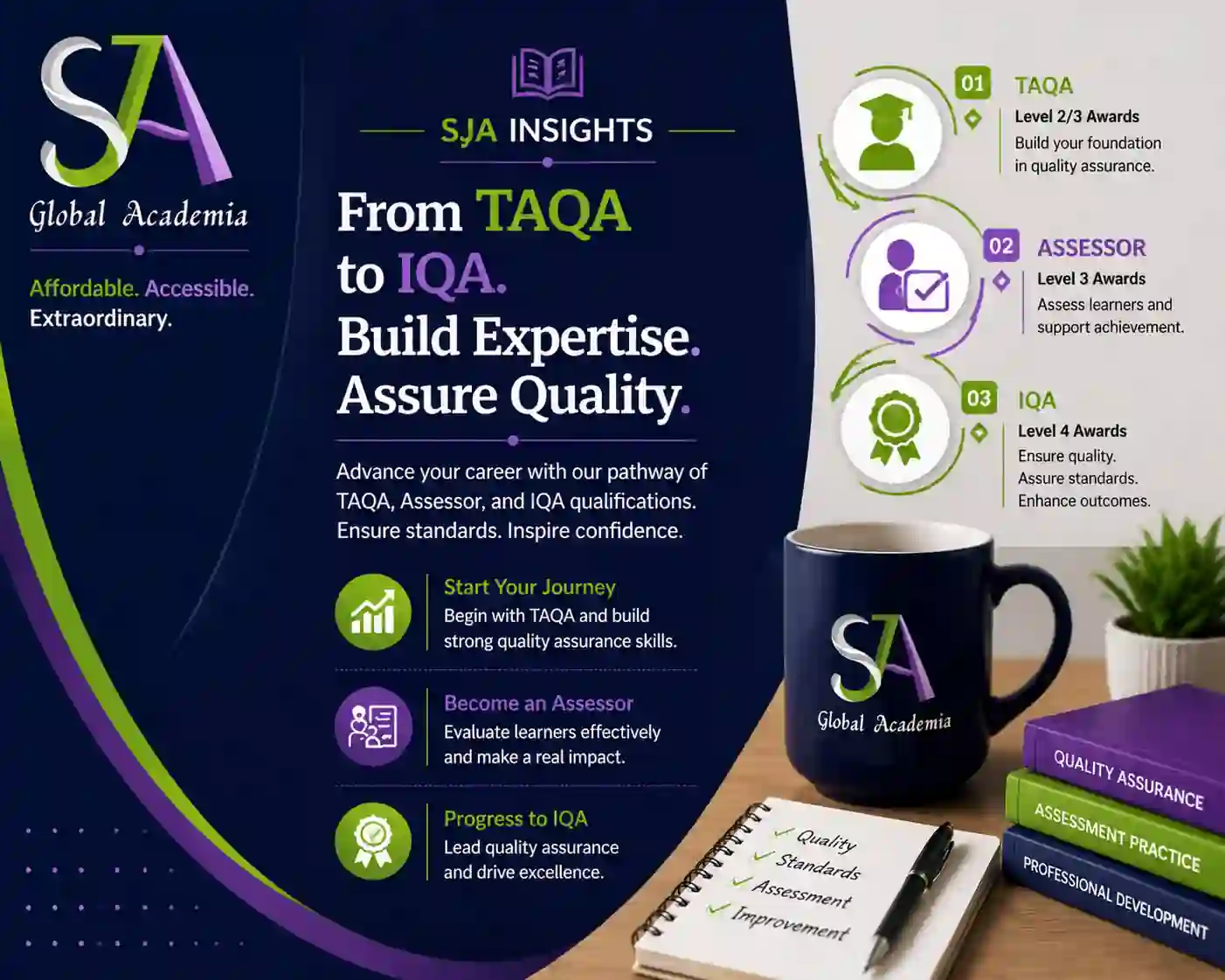
What Are Assessor and IQA Qualifications?
Assessor and IQA qualifications support professionals involved in vocational education, workplace learning and training delivery. They help practitioners develop the skills required to assess learner competence, evaluate evidence and maintain consistent assessment standards.
Many professionals begin their journey by becoming assessors and later progress into Internal Quality Assurance roles where they support assessors and improve assessment quality.
What Is TAQA?
TAQA stands for Training, Assessment and Quality Assurance. People often use “TAQA qualification” when they mean an assessor or quality assurance award. TAQA describes a family of qualifications, rather than one course.
CAVA vs TAQA: The Difference
CAVA means Certificate in Assessing Vocational Achievement. It is a specific Level 3 assessor qualification covering workplace competence and vocational skills, knowledge and understanding. TAQA is the wider family that includes assessor, internal quality assurance and external quality assurance routes. You do not need to choose between CAVA and TAQA as if they were equivalent courses.
Start with the work you need to do. Choose ACWE for workplace assessment, AVRA for assessment in a classroom or training setting, or CAVA for both. Choose an IQA qualification when your role involves checking assessment quality and supporting assessors.
What About A1 and D32/D33?
A1 and D32/D33 are older assessor awards. They are no longer the usual route for new assessors, but an existing award does not automatically become invalid. Ask your employer and awarding organisation what they accept and what evidence of current competence they require. Check your position before paying for another course.
Understanding CAVA and Assessor Qualifications
The Level 3 Certificate in Assessing Vocational Achievement, or CAVA, is a practical assessor qualification. It covers occupational competence in a real workplace and vocational skills, knowledge and understanding in a learning or training setting. It combines assessment principles with two practical units.
Which Level 3 Assessor Course Fits Your Work?
- ACWE: for assessing genuine job tasks in the learner’s workplace.
- AVRA: for assessing vocational skills and knowledge in a classroom, workshop or training setting.
- CAVA: for an assessment role covering both contexts.
Can You Study CAVA Online?
You can study the knowledge, receive tutor guidance and submit portfolio evidence online. You must still complete genuine practical assessments. At SJA you need two real learners or candidates and suitable opportunities in both contexts. Written explanations alone cannot replace practical competence evidence.
How Long Does CAVA Take?
Completion depends on your study time, access to learners and assessment opportunities, and how quickly you address feedback. Plan your evidence before enrolling and confirm the course-access period with SJA. Course completion and certificate processing are separate stages. A fast-track claim should not be treated as a guaranteed certificate date.
Does CAVA Qualify You to Assess Any Subject?
No. You also need occupational or subject competence and must meet the centre, employer and awarding organisation requirements. Care assessors and construction assessors may hold the same assessor award while having different subject expertise.
What Is a CAVA Qualification?
The Level 3 Certificate in Assessing Vocational Achievement is the full name of CAVA. A Level 3 CAVA assessor course combines knowledge of assessment with practical assessment in both workplace and vocational learning settings. CAVA Level 3 is suitable when you need both forms of assessment; the shorter ACWE or AVRA awards may fit duties limited to one setting.
How Much Does the CAVA Qualification Cost?
Compare the total payable, tutor support, assessment arrangements and certificate options when comparing fees. An initial instalment is only part of the course price. Check the current CAVA qualification cost and payment schedule on SJA’s course page, then confirm that you can access the learners and assessment settings needed for the practical units.
For a realistic CAVA qualification timetable, list the assessment activities you can arrange and when learners will be available. Our portfolio evidence guide helps organise those records. Use the affordable assessor courses comparison to assess support and value alongside the advertised duration. Speed alone does not establish whether an assessor course fits your circumstances.
Assessor vs IQA: Understanding the Difference
| Role | Main Responsibility |
|---|---|
| Assessor | Plans assessment, gathers evidence and assesses learner competence. |
| IQA | Reviews assessment practice and supports consistency. |
| EQA | Reviews centre quality on behalf of awarding organisations. |
Assessors work directly with learners, while IQAs focus on maintaining assessment standards across an organisation.
How Internal Quality Assurance Supports Assessment Standards
Internal Quality Assurance ensures assessment decisions are fair, reliable and consistent. IQAs review assessment evidence, support assessors, conduct sampling activities and contribute to standardisation.
SJA offers progression through the Level 4 IQA Award and Level 4 IQA Certificate.
Professionals can also review the Register of Regulated Qualifications for information about regulated qualifications.
The Assessor and IQA Career Progression Pathway
A common progression route begins with an assessor qualification, followed by Internal Quality Assurance and later wider quality or leadership responsibilities.
Professionals working in education and training can use the Professional Standards for Teachers and Trainers to support continuing professional development.
Those working in apprenticeship environments can also explore apprenticeship standards and guidance.
Choosing the Right Assessment and Verification Qualification
The right qualification depends on your current experience, workplace responsibilities and career goals. Professionals who want to assess learners should explore assessor qualifications, while experienced assessors may progress into IQA roles.
Explore SJA's Assessor & Quality Assurance pathway or develop wider education skills through Teacher Training.