Currently Empty: £0.00



sjatraining25
- May 30, 2026
- Comment 0
Every year, over 500,000 people die in the UK. Behind each one of those deaths is a family in need of support, a care plan that has to be managed, and a professional whose job it is to make that final stage of life as dignified as possible. Yet right now, the NHS and the wider care sector face serious shortages of trained staff who can deliver that level of care with real competence and confidence.
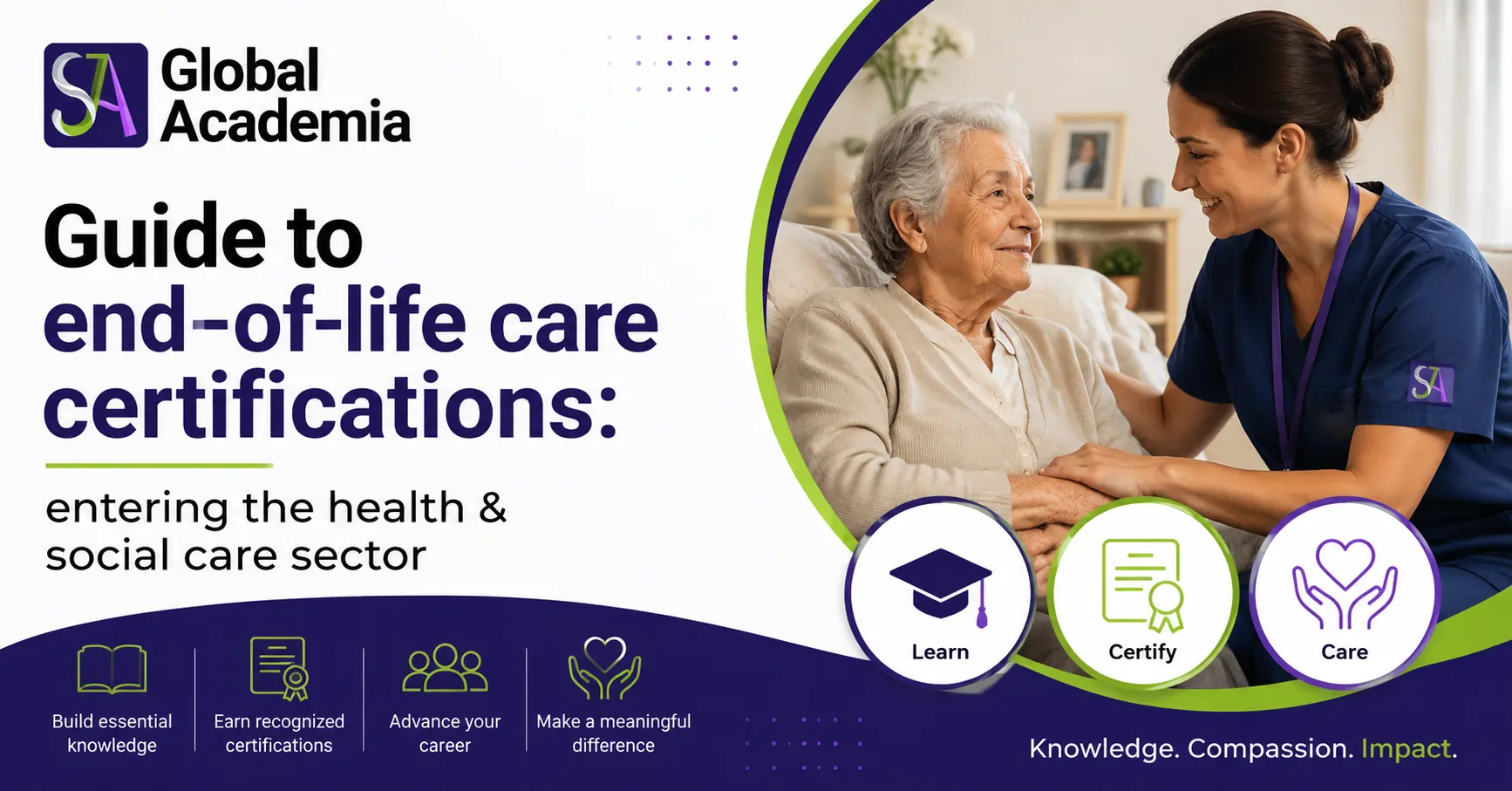
If you have been thinking about entering the health and social care sector, or if you are already working in care and want to specialise, end-of-life care certifications are one of the most meaningful and in-demand qualifications you can hold in the UK. This guide walks you through exactly what these certifications involve, which level is right for you, how they differ from other care credentials, and how you can earn yours while continuing to work.
What Does an End-of-Life Care Certification Actually Mean for Your Career?
An end-of-life care certification is a nationally recognised qualification that proves you understand how to support individuals who are approaching the final stage of their lives. It covers far more than clinical knowledge. These certifications teach you how to communicate sensitively, manage pain and comfort, support families through grief, navigate the legal and ethical considerations of dying, and deliver genuinely person-centred care.
In the UK, these qualifications sit within the Regulated Qualifications Framework (RQF), which means they are standardised, Ofqual-regulated, and recognised by employers across the NHS, care homes, hospices, and community settings. That recognition matters enormously when you are applying for roles, because employers use the RQF level as a quick way to assess your readiness without relying solely on your job history. The recognised health and social care qualifications for end-of-life and palliative care work in the UK include:
Level 2 Award in Awareness of End of Life Care (RQF)
Covers the basics of what end-of-life care involves, who provides it, and how it affects individuals and their families. A short qualification that serves as a solid foundation for anyone new to the care sector.
Level 2 Certificate in Understanding End of Life Care (RQF)
Goes slightly deeper, covering the emotional and social needs of dying individuals, the role of different care settings, and the principles behind dignified care.
Level 3 Certificate in the Principles of End of Life Care (RQF)
The most widely recognised employer-facing qualification in this area. Awarding bodies such as NCFE CACHE and TQUK both offer versions of this certificate. It covers communication skills, holistic assessment, legal and ethical considerations, pain management awareness, and how to support families. This is the qualification most UK care employers refer to when they ask for evidence of end-of-life care competence.
The Level 3 Diploma in Adult Care (RQF) builds on these foundations further and prepares you for senior care roles that include end-of-life responsibilities across a range of settings.
Which End-of-Life Care Qualifications Do UK Employers Actually Recognise?
This is where many people get confused, particularly because there are CPD-certified online courses that use the phrase ‘end-of-life care’ but are not regulated qualifications. Understanding the difference could save you a significant amount of money and time.
CPD courses are useful for continuing professional development and can support your knowledge, but they are not the same as RQF-regulated qualifications. Most UK care employers, local authorities, NHS trusts, and organisations inspected by the Care Quality Commission (CQC) will ask specifically for Ofqual-regulated qualifications at an appropriate RQF level.
The awarding bodies you should look for on any end-of-life care qualification include NCFE CACHE, TQUK (Training Qualifications UK), and Focus Awards. These are the regulated bodies that issue certificates employers trust. If a course is listed on the health & social care qualifications, you can be confident it carries real weight in the job market.
The Gold Standard Framework, the End of Life Care Strategy, and the CQC minimum training standards all reference RQF-regulated qualifications as part of what is expected from care workers operating in this specialism. If your certificate does not come from an Ofqual-regulated awarding body, it is unlikely to satisfy those standards.
Types of Life Support Certifications and How They Differ From Palliative Care Qualifications
People often search for different types of life support certifications when they are exploring care roles, and it is worth being clear about what each one does and does not cover. The table below breaks down the key certifications side by side so you can see exactly where each one fits.
| Certification | Type | What It Covers | Who It Is For | Settings |
| Basic Life Support (BLS) | Clinical skills | CPR, AED use, emergency cardiac and respiratory response | All care workers, nurses, first responders | Hospitals, care homes, community |
| Award in Awareness of End of Life Care (RQF) | Palliative and holistic | Communication, dignity in dying, emotional and family support, person-centred care | New care workers, support staff, volunteers | Hospices, care homes, domiciliary care |
| Level 3 Certificate in Principles of End of Life Care (RQF) | Palliative and holistic | Holistic assessment, legal and ethical issues, pain management awareness, bereavement support | Experienced care workers seeking to specialise | All care settings |
| Advanced Life Support (ALS) | Clinical skills | Advanced resuscitation, airway management, cardiac arrest protocols | Nurses, paramedics, doctors | Hospitals, emergency services |
| Immediate Life Support (ILS) | Clinical skills | Intermediate emergency response bridging BLS and ALS | Clinical healthcare staff | Hospital and clinical environments |
| First Aid at Work (Level 3) | Health and safety | Wound care, choking, fractures, basic emergency response | All workplace roles including care workers | All settings |
| Level 3 Diploma in Adult Care (RQF) | Full care qualification | All aspects of adult care including end-of-life, safeguarding, person-centred care | Career carers seeking full professional qualification | Care homes, domiciliary, community |
The key distinction to understand is this. BLS, ALS, and First Aid are emergency response certifications. They prepare you to act in a crisis. End-of-life care certifications, from the Award in Awareness of End of Life through to the Level 3 Certificate, prepare you to provide sustained, compassionate, and legally compliant support to someone in their final weeks and months of life. These are not interchangeable, and most employers in hospice, care home, and community palliative care roles will expect you to hold both types.
How Long Are BLS Certifications Good For and Does It Matter for EOL Roles?
BLS certifications are valid for two years from the date they are issued. Once those two years pass, you will need to complete a renewal course to keep your certification current. Most employers in care settings require proof of an active, non-expired BLS certificate for scheduling and regulatory compliance purposes. Letting it lapse, even briefly, can affect your ability to work until you renew.
For anyone working in end-of-life care specifically, the renewal requirement is worth planning ahead for. You will typically want to start the renewal process at least one to two months before your certificate expires. Many providers now offer online BLS renewal courses, which is particularly helpful if you are working shifts and cannot easily attend in-person training.
BLS renewal courses are significantly shorter than the original certification course, usually taking just a few hours. They focus on updated guidelines, refreshed skills practice, and confirmation that your knowledge is current with the latest resuscitation protocols from the Resuscitation Council UK.
Your end-of-life care qualifications, by contrast, do not carry a fixed expiry date in the same way. Once you hold an RQF-regulated certificate or diploma, it remains valid as a qualification. However, many employers expect CPD activity to demonstrate that your knowledge and practice remain current, particularly around updated CQC standards, changes in palliative care legislation, and evolving best practices in pain management and dignity in dying.
What Level Should You Start At If You Are New to the Care Sector?
This is the question most people ask when they first look at end-of-life care certifications, and the honest answer depends on where you are starting from.
If you have no prior experience in health or social care, the Level 2 Award in Awareness of End of Life Care is a practical and accessible starting point. It introduces the core concepts without overwhelming you with clinical detail, and it can be completed in a relatively short time. From there, you are well-positioned to move into the Level 3 Certificate and then into a full diploma that qualifies you for paid care roles.
If you already work in care and want to formally specialise in end-of-life work, the Level 3 Certificate in the Principles of End of Life Care (RQF) is the most direct route. Many employers will fund this as part of your continuing professional development, particularly given the current UK workforce shortage in palliative and end-of-life care services.
If you hold a current Level 2 Diploma in Health and Social Care, you can move directly to a Level 3 qualification without starting from scratch. Some providers also offer Recognition of Prior Learning (RPL), which credits your existing care experience and can significantly reduce the time it takes to complete a qualification. SJA Academia offers RPL as part of its enrolment process, which means experienced care workers often complete qualifications faster and at lower cost.
Using a health and social care assessor guide can help you map your existing knowledge against the learning outcomes of each qualification level before you commit, so you are not paying for content you have already mastered.
Can You Study for a Care Certification While Working Full-Time?
Yes, and for the majority of people entering or advancing in the care sector, this is exactly how it works. Shift-based care roles do not lend themselves to traditional classroom-based study, and the best providers have built their course structures around that reality.
Balancing work and study is genuinely manageable when you choose the right format. Online end-of-life care courses that are fully self-paced mean you can submit assignments between shifts, study on days off, and progress at whatever pace works for your schedule. You do not have to be at a set place at a set time, which removes one of the biggest barriers for working care professionals.
At SJA Academia, all health and social care courses are fully online, with 24/7 access to course materials and tutor support. Students regularly complete qualifications while working full-time on varying shift patterns. The assignment-based assessment model means there are no exam hall pressures, and you build up a portfolio of evidence from your work and study that serves as both your assessment and your professional record.
Payment plans also make a significant difference. Being able to spread the cost of a qualification across several months means you do not need to have the full fee available upfront, which removes another common barrier. The NHS Workforce Plan and Skills for Care both recognise flexible online study as a credible route to qualification, which means your employer is unlikely to question the validity of an Ofqual-regulated certificate earned online.
What Comes After Your First End-of-Life Care Certificate?
Most people who start with an end-of-life care certification find that it opens doors they did not expect. The roles that become accessible after a Level 3 Certificate or Diploma in this specialism include senior care worker, palliative care coordinator, end-of-life care specialist, and eventually care manager or service lead. Salaries in specialist palliative and end-of-life roles in the NHS range from around £28,000 to over £54,000 depending on the level of specialism and seniority.
Beyond direct care roles, some qualified professionals choose to move into training and assessment. If you are interested in delivering health and social care training yourself, whether in a care home, for an NHS trust, or as an independent assessor, the pathway from care qualifications into teaching is well-established.
For those who want to go further into professional teaching status, following a QTLS roadmap is the recognised route. QTLS, or Qualified Teacher Learning and Skills status, is awarded by the Society for Education and Training and is the equivalent of Qualified Teacher Status (QTS) for the further education and skills sector. Achieving QTLS means you can teach in further education colleges, adult learning settings, and training organisations with full professional recognition.
The career pathway from an end-of-life care certification to a teaching or senior practice role is more straightforward than most people realise, particularly when you work with a provider that supports you through each step of that progression.
How to Enrol in a Health and Social Care Course Without the Overwhelm
The most common reason people delay starting a care qualification is that the options feel overwhelming. There are multiple awarding bodies, multiple levels, multiple providers, and a great deal of terminology that is easy to confuse if you are approaching this for the first time.
The simplest approach is to identify your starting point, your goal, and your timeframe, and then choose a provider who can map those three things together clearly.
At SJA Academia, the health and social care courses cover the full range of care qualifications from entry level to diploma, and the enrolment process is designed to be straightforward. You can browse course options online, speak to a course advisor who understands the care sector specifically, and get clear guidance on which level to start at based on your current experience and career goals.
The Level 3 Diploma in Adult Care (RQF) at SJA Academia is priced at £490, with flexible payment options available. It is Ofqual-regulated and awarded by Focus Awards, which means it carries full employer recognition across care settings in England, Wales, and Northern Ireland. RPL is available for experienced care workers who want credit for their existing knowledge, which can reduce both the cost and the time to completion.
Frequently Questions Asked and Answer for an End-of-Life Care Certification
Do I need any prior qualifications to start an end-of-life care course?
For Level 2 qualifications, no prior care qualifications are required. A basic understanding of English and Maths at Level 1 is helpful, but there are no formal entry requirements. Level 3 courses are typically more suitable if you already hold a Level 2 qualification or have relevant care experience.
Will my end-of-life care certificate be recognised by NHS employers and care homes?
Yes, provided it is awarded by a regulated awarding body such as NCFE CACHE, TQUK, or Focus Awards, and listed on the Ofqual Register of Regulated Qualifications. These certificates meet the CQC standards and Gold Standard Framework expectations that employers reference.
How long does it take to complete an end-of-life care qualification?
A Level 2 Award can often be completed within a few weeks of part-time study. A Level 3 Certificate typically takes two to four months depending on your study pace. A full Level 3 Diploma in Adult Care generally takes six to twelve months when studied alongside work.
How long are BLS certifications good for?
BLS certifications are valid for two years from the date of issue. You will need to complete a renewal course before they expire to remain compliant with employer requirements. Many providers offer online BLS renewal that can be completed in a few hours.
Can I study an end-of-life care course online while working shifts?
Yes. Most reputable providers, including SJA Academia, offer fully online, self-paced courses that you access whenever suits you. There are no fixed class times, and assessments are portfolio-based rather than exam-based, which makes them far more manageable alongside a full-time care role.
Is there any funding available for end-of-life care qualifications in the UK?
The Adult Skills Fund(formerly the Adult Education Budget) may cover costs for eligible learners in England, particularly those who are unemployed, on low incomes, or retraining. Some employers will fund qualifications directly as part of CPD. SJA Academia also offers flexible payment plans, which spread the cost across several months.
What is the difference between a CPD course and an RQF-regulated qualification?
A CPD-certified course demonstrates continuing professional development and is useful for keeping your knowledge current, but it is not a nationally regulated qualification. An RQF-regulated qualification is standardised by Ofqual, awarded by a regulated body, and listed on the national Register of Regulated Qualifications. UK employers in health and social care settings will almost always require the latter for formal roles.
Can my care experience count towards a qualification?
Yes. Recognition of Prior Learning (RPL) allows you to demonstrate knowledge and competence you have already gained through work experience. This can reduce the amount of new study required and, in some cases, reduce the cost of your qualification. SJA Academia assesses RPL eligibility as part of its enrolment process.
Ready to start your end-of-life care journey?
Browse health and social care courses at SJA Academia, or speak to a course advisor today. sjaacademia.co.uk | +44 20 3432 3249 | info@sjaacademia.co.uk. Ofqual-regulated qualifications. Fully online. Flexible payments available.
SJA Academia | sjaacademia.co.uk | Health & social care assessor guides.