Currently Empty: £0.00



sjatraining25
- April 5, 2026
- Comment 0
You start searching, and suddenly you are looking at TAQA, CAVA, IQA, internal verifier, Level 3, and Level 4. It all starts to blur together. The problem is not a lack of options. The problem is that too many pages explain the qualification names without helping you choose the right route.
That matters because the wrong decision can cost you time, money, and momentum. You might enrol on a course that does not match your role, your setting, or the kind of work you want later.
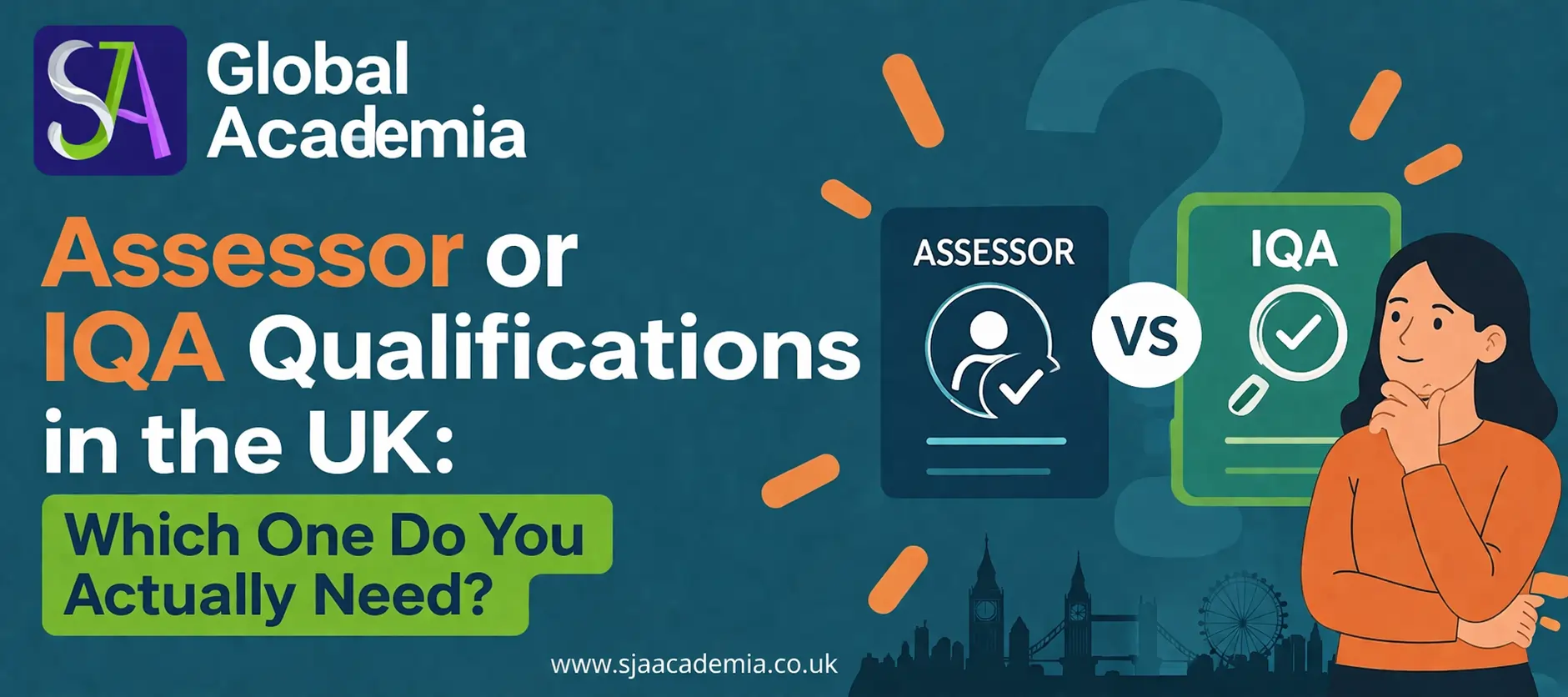
The good news is that this becomes much easier once you break it down properly. If you want to assess learners, you usually need a Level 3 assessor qualification. If you want to quality assure assessment decisions and support assessors, you usually need a Level 4 IQA qualification. The key is to match the qualification to the job you actually want.
Do you want to assess learners or quality assure assessors?
An assessor works directly with learners. They check work, observe performance, judge whether standards have been met, and give feedback. This suits people who want a hands-on role in assessment.
An IQA works behind the scenes to protect quality. They check whether assessment decisions are accurate, support assessors, and help keep standards fair and consistent.
That is why this should be your first question, not “Which course looks best?” but “Which role do I actually want?”
If you are still comparing the bigger picture, it often helps to start with Assessment & Verification courses so you can see where assessor and IQA qualifications fit within the same progression route.
If you want to become an assessor, which qualification do you need?
If your goal is to assess learners, the route usually starts with a Level 3 assessor qualification.
The exact qualification depends on where and how you assess. Some people only need the knowledge side. Some assess in the workplace. Some assess in a classroom, workshop, or training environment. Others want a qualification that gives them wider options from the start.
That is why many people end up comparing TAQA and CAVA and still feel unsure. They are trying to solve a role decision by looking only at course names.
If you want a route that supports broader assessment work, Level 3 CAVA is often the qualification people look at most closely. It can suit trainers, vocational tutors, workplace coaches, and professionals who want to assess in more than one setting.
This matters even more if you do not want to limit your options later. A lot of people want to qualify once, then move into roles with more flexibility instead of going back and fixing the wrong choice later.
Thinking about IQA instead? Here is where Level 4 fits
If your goal is to check the quality of assessment decisions, support assessors, and maintain standards, then you are looking at the IQA route.
This is usually the right direction for people who want a more senior role in quality assurance, internal verification, or assessment leadership. It often appeals to experienced assessors, but it also attracts people already working close to quality processes who want the right qualification for progression.
If that sounds like your next step, Level 4 IQA is the qualification to look at closely.
This is also where many people start asking better questions:
- Do I need assessor experience before I move into IQA?
- Will employers expect practical assessment knowledge first?
- Do I need access to assessors to complete the qualification?
- Am I ready for quality assurance now, or do I need to build assessment experience first?
Those are the right questions, because IQA is not just a course choice. It is a career-direction choice.
Confused by TAQA, CAVA, IQA, and internal verifier? Here is the simple version
This is where a lot of people lose confidence, even though the route itself is not as complicated as it looks.
TAQA is often used as a broad term linked to assessor qualifications. CAVA sits within that space. Internal verifier is an older term many people still use, while IQA is the current term used for internal quality assurance roles.
That is why search results can feel messy. One page talks about TAQA. Another talks about CAVA. Another talks about the internal verifier. You end up wondering if they are all different routes, when in reality, they are closely related but not interchangeable.
A simple way to think about it is this:
- If you want to assess learners, look at the assessor route
- If you want to quality assure assessors, look at the IQA route
- If you want long-term progression, think about the TAQA to IQA pathways rather than treating each qualification as a separate world
This is also the right place to understand IQA vs EQA, because internal and external quality assurance are not the same thing. If you mix those roles up, the qualification path becomes harder to follow than it needs to be.
What kind of assessment setting are you working in right now?
If you assess in the workplace, your qualification needs to fit that environment. If you assess in a classroom, workshop, or training centre, that matters too. If you need flexibility across both, then your qualification choice should reflect that.
This is one of the biggest reasons people end up frustrated. They choose based on a course title, then later realise the qualification does not match the way they actually work.
A better approach is to ask:
- Will I assess learners at work?
- Will I assess in a classroom or training environment?
- Do I need both options covered?
- Am I choosing for my current role only, or for future roles too?
When you answer those questions honestly, the right route usually becomes much easier to see.
What do you need before you enrol on an assessor or IQA course?
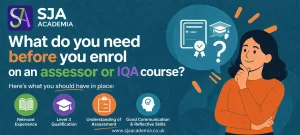
It is easy to focus on enrolment, but the smarter move is to think about what you need to complete the qualification properly. Some routes require access to learners. Others require access to assessors. Some need practical observations and evidence collected through real work.
That is why portfolio preparation matters so much. You need to know what evidence you will need, what access you already have, and what gaps could slow you down later.
Before you enrol, ask yourself:
- Do I currently have access to learners?
- Do I have access to assessors if I want to move into IQA?
- Can I gather the practical evidence needed in my setting?
- Will my workplace support observations and assessment activity?
People often think the main risk is choosing the wrong provider. In reality, the bigger risk is choosing the right qualification at the wrong time, without the access needed to complete it well.
Want a route with progression? Start with the end goal in mind
A lot of people do not want just one qualification. They want a route that grows with them.
If you start as an assessor, you may later want to move into quality assurance. If you move into IQA, you may want more responsibility, more oversight, or a broader role in maintaining standards across a team or centre.
That is why progression matters from the start. The best choice is not always the shortest route. It is the route that still makes sense a year from now.
If you know you want to build long-term options, it helps to choose a path that supports both your current role and your future goals.
What jobs can you get after an assessor qualification or IQA qualification?
People do not take these qualifications just to collect a certificate. They want a role, a promotion, more flexibility, or a way into a better part of the sector.
An assessor qualification can lead to work in vocational training, apprenticeship assessment, workplace learning, in-house training, and other roles where assessing learner competence is part of the job. That is why careers with CAVA is such an important part of the decision for many people. They want to know what the qualification can actually open up after completion.
If you move into IQA, the work becomes more focused on quality, standardisation, support for assessors, and consistency of assessment decisions. That can lead to more senior responsibility and stronger progression in training and education settings.
In some organisations, wider services also come into play. For example, Grading & Assessment support may connect closely with quality processes where accurate judgement and consistency matter across teams or centres.
Still stuck? Ask these questions before you choose
If you are still unsure, do not go back to comparing course names at random. Ask yourself these questions instead:
- Do I want to work directly with learners, or support the quality of assessment?
- Do I need a qualification for the workplace, the classroom, or both?
- Do I already have access to the people and evidence needed to complete the course?
- Am I choosing for my current job only, or for future progression too?
- Do I want to start as an assessor first, then move into IQA later?
These questions usually give you a clearer answer than any course description on its own.
Common questions about assessor and IQA qualifications
Do I need CAVA or IQA?
That depends on the job you want. If you want to assess learners, look at the assessor route. If you want to quality assure assessors and assessment decisions, look at the IQA route.
Is the internal verifier the same as IQA?
Many people still use internal verifier, but IQA is the more current term.
Can I become an IQA without being an assessor first?
Some people look at the IQA route directly, but many employers value assessor experience because it gives you a practical understanding of how assessment works.
Do I need access to learners for an assessor qualification?
For many practical assessor routes, yes. You usually need access to learners so you can complete the evidence requirements properly.
Can I study while working full-time?
Yes, many people do. The key is choosing a route that fits your real schedule and gives you the access needed to complete the practical side as well.
Final thoughts on choosing the right assessor or IQA qualification
If all of this has felt confusing, that does not mean the route is too complicated for you. It usually means the information has been split across too many pages without enough plain-English guidance.
The best starting point is to focus on the role you want. If you want to assess learners, follow the assessor route. If you want to quality assure assessors and improve consistency, follow the IQA route. If you want long-term progression, choose a path that fits both where you are now and where you want to go next.